
St Heliers · Drainlayer
Drainlayer in St Heliers
For a failed connection to a soak hole, start by sending photos of the affected area, any drainage plan and a description of when water backs up.
- PGDB licensed
- Site Safe member
- Impac Prequal assessed
- Kiwi-owned since 2012
How it works
Call or enquire
Phone us or send the address and what you’re seeing.
We assess
A licensed Stately plumber looks at the job on site.
Clear quote
You get a plain explanation and a clear quote before work starts.
Job done and tidied
We finish the work and leave the site clean.
Stately covers St Heliers. The first onsite task is to separate a damaged connecting pipe from a problem within the soakage system. That distinction determines what needs opening up and whether replacing the connection will address the reported fault.
Trace the water before choosing the repair
Show us which downpipes or surface drains feed the connection. Include photos taken during the problem, but keep clear of unstable covers and open holes. Note whether water appears beside the pipe route, at an inlet or around the soak hole itself. Send details of earlier repairs and available inspection records.
Onsite, we check accessible inlets, the apparent route and the connection point. We compare those findings with the plans rather than treating a drawn line as an exact location. A broken pipe and a soak hole that cannot accept incoming water call for different work. The repair scope follows that assessment.
Set the excavation and approval boundaries
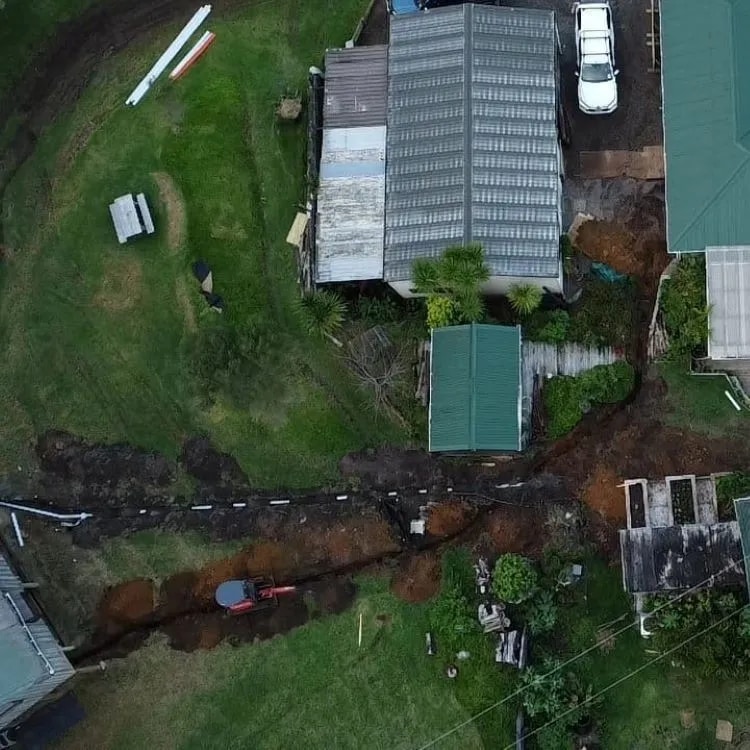
Before digging, agree the access route, working area and surfaces to lift. We locate services around the proposed excavation and establish where the private connection runs. Mark paving, garden edges and structures that need protection. Plan where excavated material will sit and how people will move safely around the work.
Restricted drainlaying must be carried out by an appropriately authorised person; check authorisation through the PGDB register. For this replacement, use MBIE guidance to check consent requirements against the actual scope. Where the assessment involves changing soakage provision, confirm the designer’s approach and Auckland Council requirements before settling the excavation extent.
More about drainlayer in St Heliers
Expose sound pipe and rebuild the junction
We excavate around the suspect connection to reveal the damaged section, its support and its entry into the soak hole. Exposing enough sound pipe matters: joining onto a cracked or distorted end simply leaves another weak point beside the repair. The exposed condition also helps confirm the proposed repair length.
Replacement pipework is selected after checking the existing material, diameter, levels and junction arrangement onsite. We lay the new section on suitable bedding, form compatible joints and support the connection so the pipe is not carrying unsupported loads. Any required entry detail is settled before installation. Keep access points reachable rather than burying them beneath permanent finishes.
Hold the trench open for checks
Agree testing and inspection stages before booking final surface work. With the pipe exposed, we check its alignment, joints, support and connection detail. Testing follows the applicable project requirements. Flow checks help assess the repaired route, while the soakage assessment addresses whether the receiving system can accept the intended discharge.
Arrange any required council inspection at the appropriate stage, with the relevant work still visible. Give the builder a clear hold point before backfilling. Record findings and resolve defects before covering the pipe. Photograph the junction and record its position while measurements remain straightforward, rather than trying to reconstruct the route after reinstatement.
Close the excavation with useful records
Backfill follows acceptance of the installed work. Protect the pipe surround and reinstate the agreed surface area. Specify whether handover includes finished paving, concrete or garden reinstatement, or a prepared area for another trade. Record any remaining surface work and who will complete it.
Provide a marked route, connection photos, testing records and applicable inspection documents. Identify access points and explain what was replaced. Owners maintain private drainage pipes; Auckland Council manages public stormwater. Keep those responsibilities clear in the handover record, especially where plans show both private and public assets.
Drainlayer: questions from St Heliers
Will a new connection fix overflowing?
The onsite assessment must distinguish restricted pipe flow from inadequate soakage. Replacing a broken connection addresses that pipe defect, not the receiving system’s capacity.
Should paving be removed beforehand?
Wait until the route and excavation limits are agreed. Early removal risks disturbing services or lifting surfaces outside the repair area.
What should I keep for future landscaping?
Keep the marked pipe route, junction photographs and access locations. Give these to the landscaper before setting levels or placing permanent features.
More help in East Auckland
Read before you call
Google reviews
Rated Excellent
Real words from Auckland customers on Google.
Excellent service and reliable people will definitely use them again
4 / 5