
Mount Roskill · Drainlayer
Drainlayer in Mount Roskill
Renewing a house drain while people remain at home starts with planning when wastewater fixtures must stop being used. Send the drain plan, photographs of access and a list of occupied bathrooms before arranging an assessment.
- PGDB licensed
- Site Safe member
- Impac Prequal assessed
- Kiwi-owned since 2012
How it works
Call or enquire
Phone us or send the address and what you’re seeing.
We assess
A licensed Stately plumber looks at the job on site.
Clear quote
You get a plain explanation and a clear quote before work starts.
Job done and tidied
We finish the work and leave the site clean.
Stately covers Mount Roskill. We check the proposed renewal route onsite and agree how occupants will move around the excavation, receive shutdown notices and know when toilets and other connected fixtures are available again.
Build the work plan around daily use
Tell us whether the house has one toilet, who needs daytime access and whether anyone needs an unobstructed route to the entrance. Include laundry arrangements and appliances that discharge automatically. These details shape the shutdown discussion before a trench is opened.
Mark the fixtures believed to use the drain being renewed. We check their connections onsite rather than treating another bathroom as independent. Agree who tells everyone to stop using affected fixtures. Where use cannot resume between stages, arrange alternative facilities before disconnection, not after the household discovers the toilet is unavailable.
Confirm the route before opening the ground
Send previous drainage drawings, repair records and photographs of inspection openings. We compare these with the visible layout, locate the affected drain and other services, and establish connection positions and levels. The renewal limits need to reach sound pipe, rather than simply match the visible damaged area.
Owners maintain private pipes, while Watercare manages public wastewater. Establishing that boundary helps define the job. Excavation near public wastewater assets may require Watercare approval. Check the actual scope against MBIE consent guidance before setting inspection stages. Restricted drainlaying needs an appropriately authorised person; check their authorisation on the PGDB register.
More about drainlayer in Mount Roskill
Excavate with household access kept separate
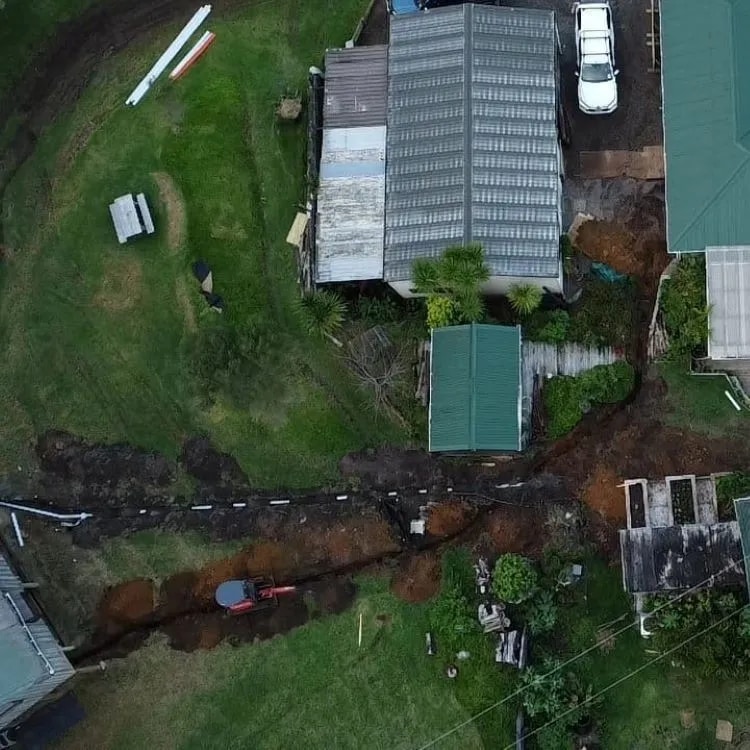
Agree where machinery, removed material and replacement pipe can go. Identify gates, paths and doors that occupants need each day. We plan the excavation footprint around the confirmed route and protect exposed work from household traffic. Nobody should need to step over an open trench to reach a toilet.
Expose the connection points and inspect the existing pipe before committing to the full replacement length. Check depth, working room and nearby services as excavation progresses. Discuss any changed renewal limits before extending the dig. Keep spoil and equipment away from the agreed access route, and secure the work area between work periods.
Lay the replacement and control each shutdown
Prepare the trench base and lay the replacement pipe to the established route and levels. Check bedding, joints, branch connections and access for future maintenance. Connect retained sections only after their condition and suitability have been checked. Pipe size and alignment are settled through onsite assessment and any required design.
Give the nominated household contact a clear instruction before disconnecting the old drain. That instruction covers toilets, showers, sinks and connected appliances. Fit testing and required inspections into the programme before covering the relevant work. Tell occupants explicitly when connected fixtures can return to use; a finished joint alone is not that instruction.
Close the trench and leave usable records
Record the installed route, connection points and inspection access before backfilling hides them. Complete the applicable testing and obtain required inspection acceptance at the appropriate stage. Then backfill and compact around the pipe using the agreed method, keeping access points available rather than burying them beneath the finished surface.
At handover, provide drainage records, test information and inspection documentation relevant to the work. Walk through which fixtures are back in service and show the access points. Record whether paving, lawn or concrete has received temporary reinstatement or its agreed finish, including who completes any remaining surface work.
Drainlayer: questions from Mount Roskill
Can we use another toilet during renewal?
Only after its drainage route has been checked and confirmed usable during that stage. Two toilets can share the section being disconnected.
Should we run the dishwasher before work starts?
Ask when the shutdown begins and allow its discharge cycle to finish beforehand. Disable delayed starts for appliances connected to the affected drain.
What should we keep after the trench is covered?
Keep the updated drain route, photographs, test records and applicable inspection documents together. Retain the surface reinstatement agreement until all agreed finishes are complete.
More help in Central Auckland
Read before you call
Google reviews
Rated Excellent
Real words from Auckland customers on Google.
I had the team come out to install a gas hot water system for me recently and it was an absolute pleasure to have these guys come out and do some work for me. The response time from me requesting the work, to the work being completed, was the best I have ever had! They showed up on time, the communication was great, they are super efficient and they did a top quality job! Couldn't ask for anything more. Highly recommend these guys!
1 / 5